

All of these things are important
Is everything on your list a priority? That's not a problem. That's the goal.

Years ago, I had a coach who would write how fast he wanted us to swim each set on the practice sheet. The problem was that it came out like this:
Fast. Fast Fast. FAST. VERY FAST!! SUPER FAST!!!!
I suspect many of our task lists look like this. We refer to the items on the list as priorities and can only distinguish between them by tagging them as a low or a key priority. My planner calls out top priorities — plural.
We like to say that when everything is important, nothing is. But what do you do when everything on your list is important?
.
What is a priority?
The word priority has evolved. In the late 14th century, the word was prioritie, which meant the "state of being earlier (than something else), prior occurrence or existence.”
In 1897, Century Dictionary wrote, "Priority is the state or fact of coming first in order of time; what little use it has beyond this meaning is only a figurative extension.”
In the 20th century, it shifted to "fact or condition of coming first in importance or requiring immediate attention; thing regarded as more important than another or others."
Now a priority isn’t only about order but importance. Deeming something a priority means it requires immediate attention.
And then priority became priorities.
.
Priority expanded to cover more stuff
We have things to do at our job(s), things to do with our friends and family, and things to do to maintain our life (think grocery shopping or swabbing that toilet). And that says nothing of our hobbies, any content we create, or the ever-present urge to scroll through our social media feed which reinforces the false narrative that we aren't moving fast enough.
To keep up with our heightened state of overwhelm, the word priority expanded to the plural — priorities. Before 1900, the word priorities rarely appeared in print. Starting around 1940, however, that changed.
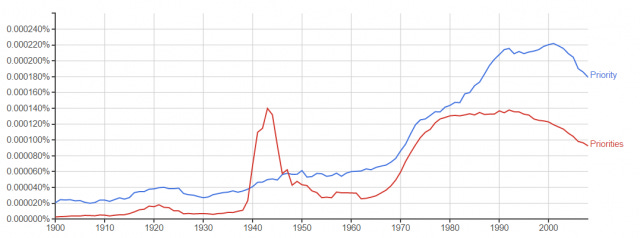
Many of us exist under the assumption that we don’t have one thing that needs our immediate attention; we have numerous things that do. We’ve taken a realistic dose of urgency and amped it up so we’re constantly racing from one thing to the next, the underlying current of panic sustaining our pace until we crash and burn.
So what do to? I see two dominant responses.
First, we’re trying to differentiate the important from the IMPORTANT. My planner doesn’t ask for my priority, it asks for my three Top Priorities (capital T and P), which suggests I have way more than three priorities.
Second, we’re trying to eliminate distractions and other items that aren’t worth our time.
The first response tries to solve the problem by elevating only a few items; the second tries to narrow the list down to only a few items. Both ultimately seek to recover the glory of the singular priority.
I always start with elimination. We often label things important that are not important at all. “No” is our most powerful weapon when managing everything that requires our attention.
But we can’t say no to everything. However you slice it, even the most disciplined No wielder (and I put myself in this warrior camp, No-sword permanently affixed to my hand) struggles to find a way to manage all the things that we consider important and deserve our attention.
Instead of equating a priority with something that’s important, we need to return to an older definition of priority.
.
.
Order > importance
I disagree with the idea that if everything is important, nothing is.
If everything on your desk is important, you’ve hit the jackpot. The entire point of the value economy is to reach a place where our time goes only to the things that matter.
In an ideal world, doing what matters fits neatly in the 24 hours you have in a day. But this is not an ideal world. For those of us who overflow with ideas and curiosities, there will always be more to do than we can get done — and all of it may be important.
As we redesign work, businesses shift their focus to delivering value. They filter out the things they shouldn't pursue so their time goes toward the things that matter. Like people, that doesn't mean they don't have a mammoth list of things to do — all of which may be important.
This leaves us in a moon launch, graduation situation.
Several years ago, I sat on a particularly uncomfortable chair in a frigid hall mid-way through a startup event. There was much swag and innovation tossed about. I remember little except one speaker who said, “You can fly to the moon and go to your child’s graduation. But you can’t do both on the same day.”
While perhaps a bizarre comparison, this situation illustrates the situation many of us confront each day.
Everything we need to do is important, but we can’t do it at the same time.
We need to shift from trying and failing to out-important ourselves and get comfortable saying it’s all important —it’s simply not all important right now.
.
Prioritize instead
I got a new planner recently. Instead of allowing it to smother me in multiple levels of priorities, I adjusted it to talk about my monthly, weekly, and daily focus.
I no longer try to rank items based on how important they are (*cough* almost all of them matter). I start with my focus and determine which items need to get my attention during that time frame.
For example, I set my focus last week to “Moving.” I prioritized booking the moving company, closing out accounts, and packing up the place because they were the items that needed my attention and the order in which that attention was required. I could then better prioritize my tasks each day as I moved through the week.
And lest ye think all the other things disappeared, I have a system to organize all the things I have going on now, next month, next year, and beyond so I don’t lose track of anything, including all the surprises that show up as I try to stay focused.
The same principle can be put into practice by teams. Determine the focus for the month or quarter. It will help your team members know how to allocate their time. It will also help you decrease FOMO and panic when surprises show up along the way. Acknowledge them, collect them, evaluate them. Then be OK with either a hard pass or saying, “Yes, but not right now.”
This approach gets to the heart of the issue. It isn’t ultimately about what we call a priority (noun); it’s about our ability to prioritize (verb).
When you set a focus and prioritize what needs to get your attention during that time frame, you have a better way to navigate through the things that matter — and actually get shit done.
.
.
I'm glad I prioritized reading your post!