

How you can make AI useful
AI is a tool. Here are 4 questions to ask when approaching how to use it.

I cannot recall the conversation, only this statement smacking me in the face: “You’re a tried and true person.”
I blinked. She continued. “You aren’t going to start using anything unless it's been proven. And if you’re already using something that works, it’s going to take a lot for you to make a change.”
It wasn’t a compliment or a criticism, merely an observation delivered with a smile and maybe a little too much of that all-knowing upperclassman flair. But she was right. My shiny objects don’t come wrapped in code. I bemoan changes to the UI I’ve gotten used to using (darn you, Gmail). And I can’t seem to get rid of my paper desk calendar.
During a networking call, I shared my stance that AI is a tool like any other tool and got myself invited to the AI Salon to give a talk on exactly that.
You can watch the talk here or read the post below. Or both. Totally up to you.
.
What is a tool?
We use the word enough, but what does it mean? According to my friends Merriam and Webster, the word “tool” has a few definitions. The one most relevant to this conversation is “a means to an end.”
For something to be a tool, it needs to help us get to some end. The object or tech or approach or whatever is not the end itself.
.
Fire ➔ Thneed ➔ AI
As a species, we’ve had tools for a long time, but how we discover and hone them has shifted. I’m going to chart the path from fire to the Thneed to AI.

The discovery of fire is a pivotal moment for our species. Our ability to use fire as a tool had lasting effects on our biology, our place in the food chain, and our quality of life.
A brief Google search (I shan't give my actions the dignified title of research) taught me that we aren’t 100% sure how we discovered fire. Researchers think we observed brush fires and gleaned the usefulness of fire from them.

We might have benefitted from the warmth of tree roots after a brush fire and reaped the nutritional value of any animals that the fire killed for us. Seeing what it could do, we may have taken a stick, stuck it in the brush fire to light it, and went from there.
We used fire as a tool for cooking and then to forge metal tools, which we created to kill and prepare new foods we could cook in the fire.
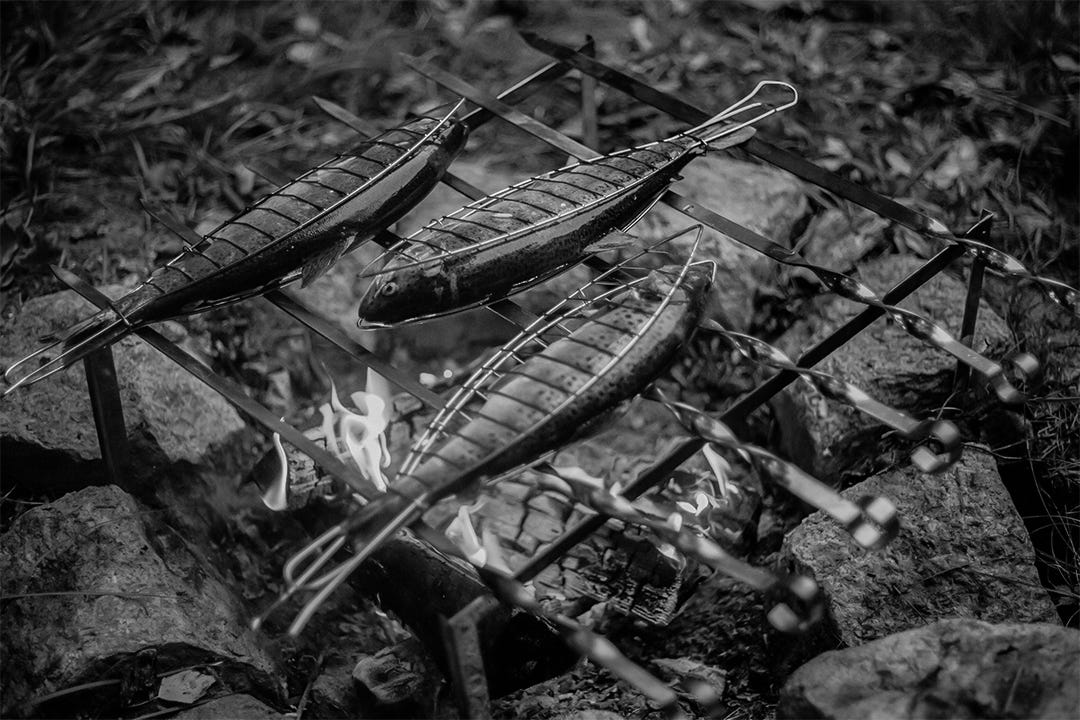
Like any tool, there are two sides to the coin. What we created to help us eat could be transformed into weapons that could help us kill off other groups. Maybe that was necessary for survival at some point, but arson and murder (with sharp metal objects forged in fire or otherwise) are now crimes.
With fire, we observed something naturally occurring, understood its use, and harnessed it to use it as a tool toward specific ends. It improved our lives by helping us get something we needed (food) in a better way.
As we evolved as a species, we moved past needs to wants — although we often describe wants as needs.
The Thneed is a quintessential example. The Thneed features in the Dr. Suess book, The Lorax. The Onceler comes to town, chops down a Truffula tree, and makes a Thneed.

He described the Thneed as “a Fine-Something-That-All-People-Need! It’s a shirt. It's a sock. It's a glove. It's a hat. But it has other uses. Yes, far beyond that. You can use it for carpets. For pillows! For sheets! Or curtains! Or covers for bicycle seats!”
The Lorax can’t imagine anyone buying it, but lo and behold, someone walks up and pays for one. The Onceler responds, “You never can tell what some people will buy.”
Many businesses throw Thneeds at the wall to make money. They don’t care if you need it; they simply want to sell it. Whether or not it ever becomes a tool — or anything valuable — varies.

And now we have generative AI.
As the name suggests, it generates. We’ve moved from people making Thneeds to technology making exponentially more Thneeds.
It seems foolish not to embrace such power. It’s also overwhelming when you stare down the list of things AI can do (write a blog post, take meeting notes, make images, analyze your data, answer customer questions, design new drugs, predict the future…). It’s easy to let FOMO take over and do things for the sake of doing them.
Value. That’s the point.
Remember, a tool is a means to an end. AI is the tool; value is the end. Using AI to use AI is not the point.
Here are 4 questions to ask when using AI as a tool
1. What’s the point?
You knew it was coming. This question is where I start. We need to know the end to determine the best means.
For example, my company is looking at ways to better handle large volumes of qualitative information. Speed is part of the point — we want to move through it faster — but we also want to access that information more easily throughout the process. Being able to ask questions that return a human response seems useful and would help us drive value for our clients.
.
2. What changes? What do we lose?
If you start using a different tool than you used before, something will change. That may be great, it may be neutral, it may be shitty. Ask the question.
One of the layers of change I find most important is loss. What do we lose if we go about it this way?

In the case of analyzing qualitative information, we, as human beings, would no longer go through the data for ourselves. Yes, we may get more time (to be determined) and additional insights (to be determined), but we would lose a level of intimacy with the information because we would no longer comb through it line by line repeatedly.
Understanding what we stand to lose made us more specifically mindful when evaluating potential platforms. For example, can we find one that allows us to go line by line if necessary? Does the platform cite its answers so we can dig deep selectively? Do we have the machine take us so far and pick it up from there to preserve our handle on the insights?
.
3. Am I making it hard?
New tools can simplify whatever we’re trying to do as easily as it can make it more complex. It doesn’t matter how shiny that new piece of software might be — if you have to work twice as hard to do something, it’s not helping you.
One of the questions I ask before diving in is, “Is there repeat value?” If it’s a task I will do once, I go for whatever is the most familiar and, therefore, the easiest way to get the job done. If I can see that this is a process I’m going to do over and over, or if it’s data I can use again, I’m more likely to consider a more complex solution because the upfront investment will pay dividends.
In the case of qualitative data, the process would be different but not significantly more or less complex than what we currently do. Moreover, it’s a repeatable process, so we (and our clients) would reap future benefits.
4. Should I?
Just because you can doesn’t mean you should. The tools we adopt have the power to shape the world in which we live. Does using AI to achieve your end help to create a world you want to live in?
I consider this question broadly and in each instance of exploring new tools, AI or otherwise. There’s no easy answer, and we can’t predict the future. We can only take it one step at a time and assess.

It’s easy to start with the tool and then figure out what to do with it. Unfortunately, that begs the question: are you creating what you want to create, or are you fitting your ideas into the box in front of you?
AI is no different. By approaching it as a tool, you’re in a better position to achieve what you want to achieve than conforming to the machine (or the big corporation behind it).