

Sometimes you don't know
Don’t hide your knowledge gaps. Put them out there so you can fill them.

“What do you mean it’s closed?”
My mother stood air fried on the sidewalk in front of a man in a gray shirt. She appeared to any passerby like a child whose bright red balloon had just been popped. Standing there with only an empty stick, I dare say that tears were imminent.
The man repeated himself with the addition of “I’m sorry,” to the first half of his statement, as in “I’m sorry, but we’re closed for a private event.”
I’ll spare you more detail and say that her pleading (We came all the way from Philadelphia…) gained us sufficient sympathy and, with our metaphorical red balloon reinflated, entrance to the Boston Fire Museum.
The Boston Fire Museum has occupied the old firehouse at 344 Congress Street in Boston’s seaport district since 1983. The museum committee, which oversees the operation of the museum, is an all-volunteer group dedicated to informing friends and visitors about the history of firefighting. Since the Boston Fire Department is one of the oldest in the nation, there’s a lot to share.
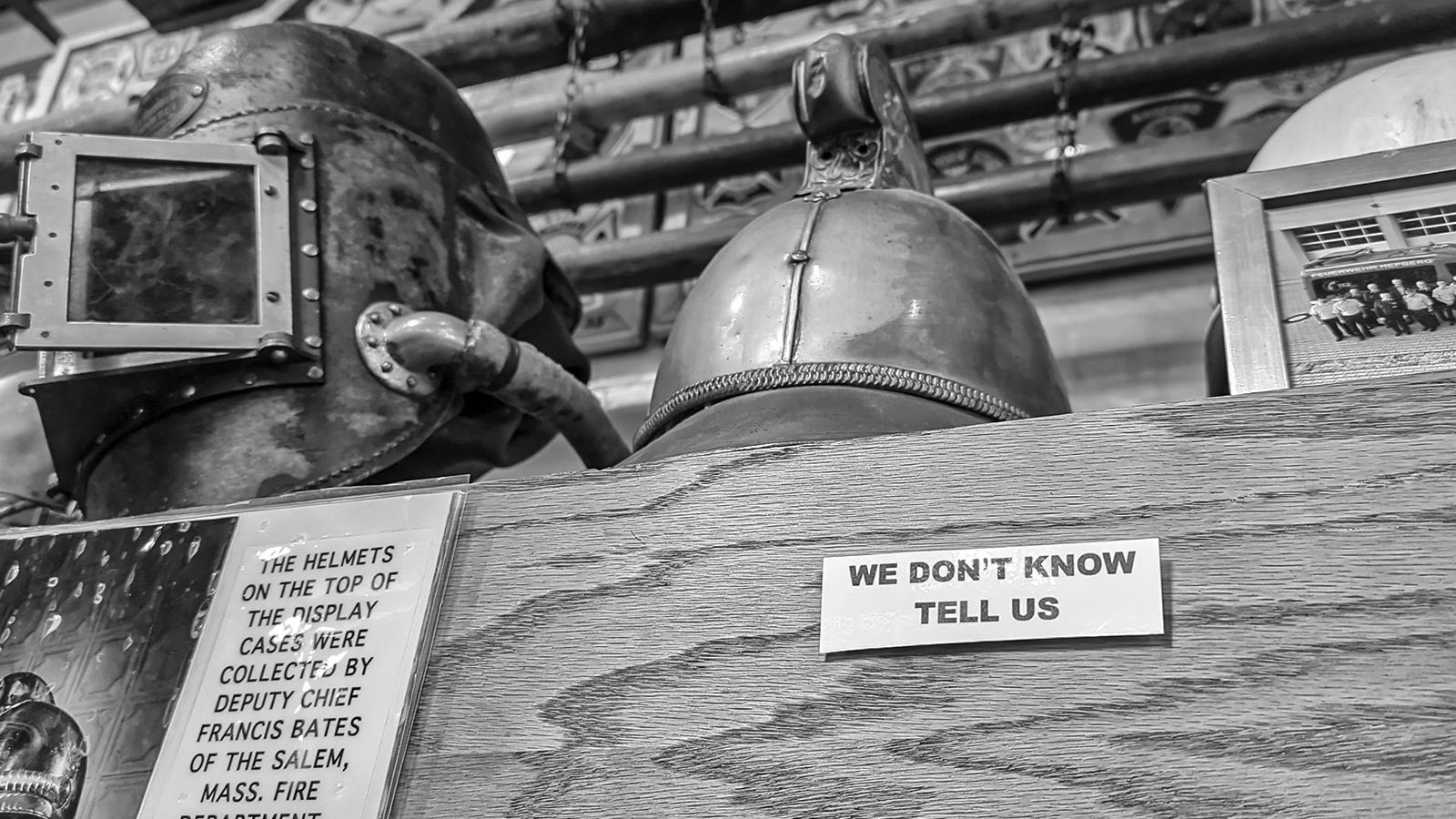
Part of their collection includes different helmets. These helmets line the top shelf running along one wall of the space. According to the note I found near the helmets, they were collected by Deputy Chief Francis Bates of the Salem, Massachusetts Fire Department.
Some helmets hail from as far away as Australia and some appeared quite old. One antique gold helmet had a different notation underneath its perch:
.
WE DON’T KNOW. TELL US.
.
Maybe your instincts kicked in and you thought, “That doesn’t seem like a good thing to put out there…”
Me? I thought it was brilliant.
Instead of hiding this helmet behind the fridge and pretending it didn’t exist, this group chose to be open about their knowledge gap in order to fill it.
The Boston Fire Museum isn’t the only business with a knowledge gap. Newsflash — no one knows everything.
Your role as a leader isn’t to have all the answers; it’s to own a knowledge gap when you find it and choose an approach to acquire that knowledge.
In this case, the museum committee chose to crowdsource an answer from the museum’s many visitors. You could also tap into your collective brainpower by asking your team. You could do some research to find an answer. You could run experiments or engage someone with the expertise you need.
Your approach will vary depending on the type of knowledge you’re trying to obtain. Seeking knowledge on a regular basis will allow your team to build that muscle so they become more adept at it over time.
And even if you can’t achieve a total gap closure, you still know that it’s there to be filled in the future.
Happy Monday,
Katie
Your Friendly Weekly Writer
.
.