

The emptiness of stock smiles
We've managed to produce a world that's boring, but we can create something better.


I explore the city one step at a time. The same blocks impart different knowledge depending on the frame I bring to them.
It took several passes for me to notice that three banks sit close to each other on two blocks downtown. Looking at one bank square in the storefront, I saw a photo of an older Asian woman with glasses. She pretended to smile in the vertical banner that doubles as lobby decoration and sidewalk eyecatcher.
Stock photo. Yeah, okay.
I eyed the next storefront and saw the same woman. With the same smile.
By the time I reached the third bank, I realized I couldn’t name the banks. And after a few more blocks, I also realized the same woman appears in a number of the photos my company uses, flashing that same smile as bright as it is empty.
Crap.

The stock photography industry started in the 1920’s. Newspapers and magazines kept photographers employed, but stock photos provided another avenue to revenue for photographers. As far as the publications were concerned, “licensing images was significantly cheaper and more accessible than commissioning a photographer or buying out the rights for a freelancer’s shots, and the chance to quickly access photos sped up their workflows considerably.”
Aside from digitizing libraries, which allows them to be larger, more widely accessible, and more easily searchable, the value proposition for stock photography remains largely unchanged. With the clack of a couple of keystrokes, I can pull up dozens to thousands of images that align with my query. I scroll through a few pages, find an image that works, and download it with the click of a button.
The reason Cheryl — let's call her Cheryl — shows up in so many places is because she's part of the Adobe Stock library. Adobe Creative Cloud subscribers get access to ten images a month for free, which reduces the friction even further.
ProDesign Tools estimates that as of 2022, there were nearly 30 million subscribers. Given the volume of content we feel we need to produce, it's no wonder we're reaching for prefabbed parts we can get out the door for pennies on the dollar. And given the number of designers using Adobe, many of us reach into the same, near friction-free well.
Generative AI is poised to ensure Cheryl appears everywhere. In essence, when generative AI produces a sentence, it predicts the next most likely word in that sentence based on the structure of all the sentences it's been fed. It's imitating the way a child starts using a word they don't understand the same way you do because that's how they're accustomed to hearing it used.
Image-generating AI — a subset of generative AI — gets trained on images rather than words. These models reference a world already abundant in Cheryls and produce more Cheryls or Cheryl look-alikes. As it then ingests the images of Cheryls it generates, those images occupy an increasing amount of its dataset1. We won't have three banks next to each other using images that feature the same model; we’ll have essentially the same twelve models appearing everywhere. All smiling that same all-too-perfect smile.
On the other hand, there’s Keegan McNamara. He realized that all computers look like each other. In addition to a lack of distinction or beauty, he also thinks they fail at helping you to get work done. “The experience is awful,” he said in an article for The Free Press. You’re getting bombarded with notifications, along with all the ills and distractions of social media. It stops being a tool.”
So he decided to build the type of computer he sought. He built “The Mythic” by hand, complete with a base of solid maple and walnut wood and an Italian leather wristrest. It runs on an operating system called NixOS, which only provides the essential function McNamara requires.
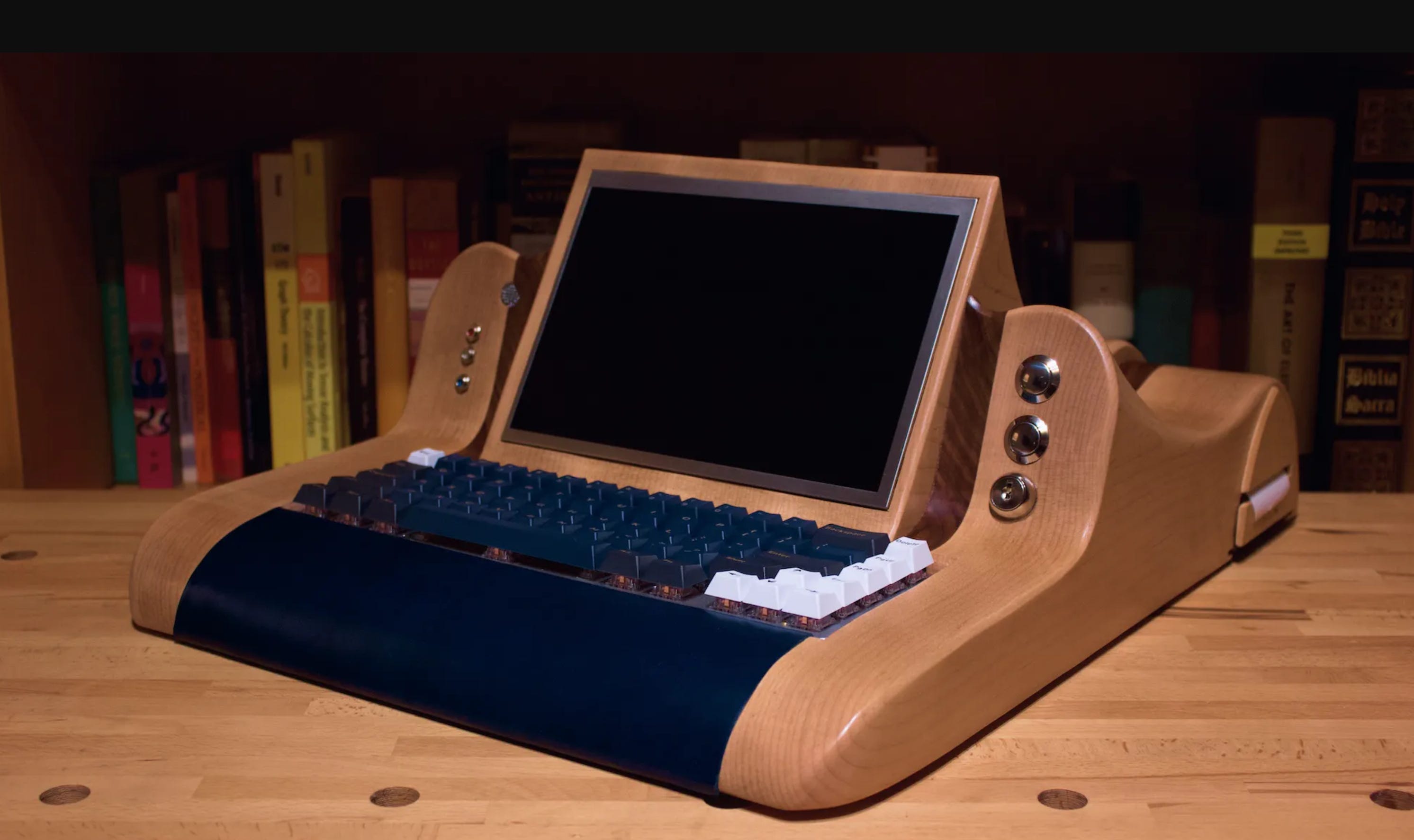
He was inspired by a visit to the Metropolitan Museum of Art. The collection of ornate guns made for nobility, like Catherine the Great’s pistols and King of France Louis XIII’s flintlock gun, caught his mind.
“It was kind of a light bulb moment for me,” he said. “These people thought it was worthwhile to turn these relatively utilitarian objects, things that were basically just tools, and transform them into something beautiful. I tried to think, do we have anything like that in modern times?”
I believe he's nailed something I've been groping at for years. Our need for more degraded our need for resource efficiency from something that benefitted us to something that stripped the world of what makes it wondrous — both visually and mentally.

McNamara’s work acknowledges that this isn’t only about aesthetics; design covers how things look and how things work.
Computers come stuffed with software I didn’t ask for and frankly don’t need. The marketing strategy popularized by ClickFunnels has proliferated to the point where the formula is more recognizable than the information contained therein.
You can also see it in how we, as individuals, gobble up prefabbed toolkits. (If it worked for them, maybe it will work for me). And that says nothing of the influencers — wise to this behavior — who package up what they do as a silver bullet that will work out of the box for you the same way it did for them.
All thought and specificity has been removed.
I’m bored. I believe many other people are bored, too. Bored of seeing Cheryl everywhere. Bored of picking out a laptop that looks like all the other laptops. Bored of getting emails that read like all the other emails.
We’re also bored of creating things that require Cheryl in the first place.
There’s no reason not to learn from others’ success or to build on established practices. We expect the crosswalk sign to work the same way regardless of where we are; doing something drastically different could cause confusion or chaos.
But even within the bounds of useful familiarity and proven tactics, there’s ample room to make specific choices for specific reasons. To think about what we’re creating, to experience a level of friction in creating that makes the work satisfying, and to take the time to make something worthy of us and worthy of the people who will experience it.
You have to make the deliberate choice to make that investment. You also have to find other people seeking that value. The Free Press rightly asserts that McNamara’s clients are people who can afford a “computer assembled like an antique clock” to their exact specifications and are willing to wait several months for its creation.
Going back to the example of stock photography, maybe you start small. I'm shooting my own photos for WTP this year, even if I use my phone. If you don't feel you can do that, use less common stock libraries or scroll to page 54 in the search results to avoid selecting the same images everyone else is using. Or find another area where you can put the time and thought into being specific and distinct.
McNamara and the virality of Alex Murrell’s2 article give me hope that we’re not only capable of pushing back but that there’s a growing number of people asking, couldn't this work better? Couldn't it be beautiful? Couldn’t I enjoy making it more?
Yes, whatever you're thinking of, yes, it can.
I’m assuming designers start using AI platforms to generate what amounts to stock images alongside the reality that these platforms get trained on stock image libraries.
This article by Alex Murrell dives deep into the reality that everything looks the same.