

Wait, so value is binary?
No. Like so many things, it exists on a spectrum.


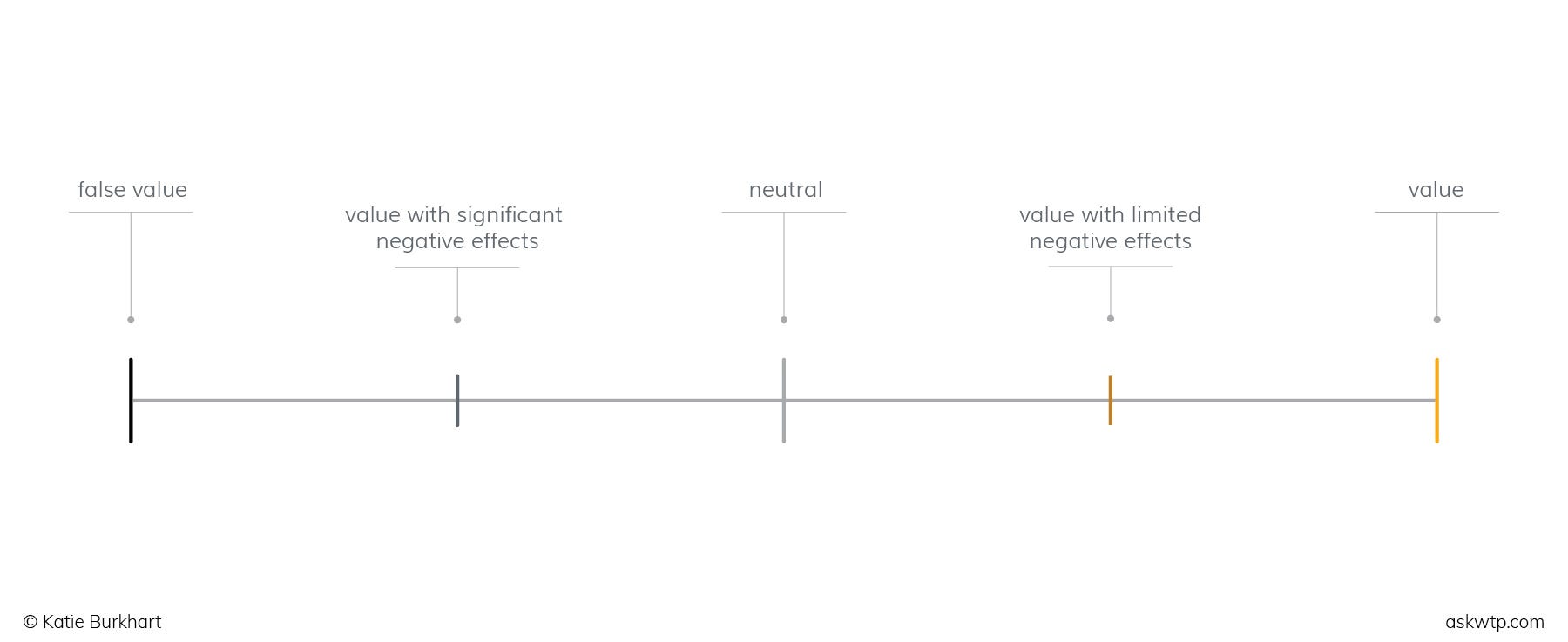
My series on false value may cause you to conclude that value is either true or false. After some reflection, I’ve determined that value falls on a spectrum. While there's room between them, these five points mark the most important distinctions on the value spectrum.
.
The 5 points on the value spectrum
1. False value
False value is wholly false. You made an exchange for something that gave you no value in return. In fact, that something may even harm you in return.
.
2. Value with significant negative effects
When you experience some small amount of value and a lot of ugly downsides, you made an exchange for value with significant negative effects.
Let's look at processed foods, specifically foods you can nuke in the microwave. I get value from these products because I don't want to cook. I don't want to take the time to prep the food, cook the food, and clean up the food. Things I can pop in my microwave for a few minutes make my life better.
They also tend to kill me. Okay, not immediately right then and there, all frozen meatballs in the kitchen with a knife, but processed foods have been shown to lead to all kinds of horrible health issues, from obesity to heart disease. I decided that for me, the significant negative effects outweigh the value delivered by the ease of the microwave. I now cook more frequently.1 I also invested in Pyrex containers to freeze the leftovers for later.
.
3. Neutral
Weird, right? Who makes an exchange for neutral value?
Lots of us, actually. You can associate these exchanges with the phrase, “six of one and half a dozen the other.”
For example, say you don't care what car you ride in to pick up the cheesesteaks because you’ll be in the front seat talking to a family member either way. The value is the same.
You can also associate these exchanges with sentences that end, “...but I won’t be any worse off.” Say you decide to go to an event that may or may not get you the result you seek, but it's free, doesn't last long, and fits into your schedule. Even if you don’t get the value you wanted, you conclude you’re no worse off for going.
.
4. Value with limited negative effects
If you're a longtime reader of this newsletter, you've heard me talk physics when discussing impact. In short, the concept "for every action, there's an equal and opposite reaction" is worth keeping in mind when assessing how effectively you're delivering value because it will surface where you're creating negative effects — and most everything has a downside somewhere.
When the downsides you experience are minor, you made an exchange for value with limited negative effects.
I enjoy watching documentaries, movies, and TV shows, so I keep a TV in my living room. I know I experience negative effects, namely that I tend to lose more hours to the activity than I deem worth it. The negative effects are limited, and I can contain them further without too much difficulty by setting a timer or only watching TV when I know I have an appointment or activity that will force me to turn it off in a reasonable amount of time.
.
5. Value
And then there are things wholly valuable. You know what you're exchanging for, you get it in spades, and it only serves to make your life better.
Shouldn’t we strive for only value?
Adam Mastroianni makes the case that we stay at the same healthy level of happy because our control systems keep us from being too happy or too sad. I think there's an interesting argument to be made that we need some amount of negative effects in our culture. A value-only existence wouldn't be any better for us than mania is.
Wholly false value, however, causes a lot of damage. We need to understand the difference and properly identify what's at play.
.
So we have to talk about it.
We have to be able to talk about value with all the nuances involved. Someone may perceive something as valuable that we would never find valuable ourselves. Someone may also consider something false value that you might perceive as having value, but with significant negative effects we need to mitigate.
We have to engage in conversation and good-natured debate to elevate essential value and contain false value. Understanding that value falls along a spectrum gives us a place to start.
.
One of the best ways to support my work is to share it. Share this post with a friend or click the 🖤 so more people will discover it on Substack. Thanks. You rock my socks.
If you have suggestions for simple ways to make food taste better without making it unhealthy, I’m all ears. I'm currently exploring air fryers.